Monday, November 8, 2010

Heading south…

To see photos click on this link

With inspiration renewed, and new skills under our belts, we set off for south, firstly to Panama. A day and a night of travelling by thumb, we met all sorts of people during which we encountered our first woman driver who gave us a lift as well as a religious truckie who preached to us for most of the way and told us how he converted himself six months ago (being a smoker, drinker and frequenter of brothels) while watching an Adventist priest on TV telling him, “you are the next one”, and he got down on his hands and knees and accepted this as a sign to convert. We arrived 50 kilometres from our destination in the dead of the night. Sleepy heads were jolted up and a surprise policeman took us under his wing, giving us refuge from the Panamerican highway and providing each of us with a mattress. Welcome to the cops bunkroom.

A few days of camping on the beach followed, a welcomed treat after some hard work on the ranch. Every night god’s light bulb was shining on our heads and the waves caused a rhythmic sound to which to sleep to.

A mini Carnaval greeted us at the Festival de la Mejorana in Guarare (named after a small guitar with 5 strings originating from the region) where we danced in the rain while watching and being part of the parade, floats passing by with girls dressed in colourful, traditional dresses with long plats sitting on either side of their necks, celebrating the many traditions that make up Panama. Many pageant queens were displayed on podiums while drums and bottles of rum and aguardiente were being swigged. The kids performed traditional dancers of the region, the boys dressed with a straw hat and a peasant costume, pranced around while the girls rustled their colourful dresses. Some of the ‘couples’ were no more than 5 years old. We watched on with a lot of laughter as some of the boys missed their steps while they became distracted by a fly or adjusted their hats, leaving their partners hanging.

On our way back from the Carnaval, we jumped into the back of a ute with a friendly driver and his friends. A few minutes into the drive, I could sense that we were swerving from side to side, veering from our lane on a very constant basis. The drivers friends were both drunk and I figured so was the driver. I became tense and wanted to jump out. In an instant, we were on the opposite side of the road with oncoming traffic heading our direction. I yelled at the driver to move back to his lane and at the last second he swerved back onto the right side of the road. Hearts beating I asked for the car to stop and we got out, the ute continuing on with no thought of what had just happened, what could have happened.

From Panama to Colombia we flew, a simple 2 hour flight that took us all day to accomplish but got us a little closer to our destination, Venezuela. We arrived at the border between Colombia and Venezuela in Cucuta, greeted by some couch surfers who went out of their way to pick us up from the airport, two hours later than the planned arrival. Taken to what seemed like a palace that night in my tired daze, we were presented to the gang of friends that never left each other’s side. Andres, Paula and ‘Los gordos’ treated us like kings, chaperoning us around Cucuta, presenting us to everyone they knew and making us stay out late on both nights we were there. Andres, a journalist, knew everyone in town and is an obvious candidate to be a politician as he so wishes. With great pride, he showed us his city and took us on a wild goose chase from place to place, stopping by for aguardiente shots at the university hangout. Andres, Paula and one of the ‘gordos’, Sebastian, about to set off on a long trip from Colombia to Argentina filled us with question about our travels. Most people had little faith that Paula and Sebastian would make it very far, use to being at home and looked after by their parents, Paula’s parents especially feared that she was destined to doom and the trip was a running joke between all. But they set off on their trip as planned and are still going strong.

While in Colombia, I was made aware that Colombian men manicure their hands and take great care in the appearance of their nails. While we were sitting drinking cheap beers in Venezuela having crossed over from Colombia for the night, the nail topic came up and we were with surprise, shown the five or six pairs of men’s nails from the group, all with varnish and looking much prettier than mine. On the other hand, men seem to pay less attention to their weight as they do to their nails, many surprisingly obese or close to it.

In Cucuta, we learnt how Venezuelan politics had affected the city and reduced trade between the two countries. We crossed over to Venezuela and discovered some more about the politics of Chavez and its implications.

Most people in Venezuela are either Chavistas or anti-Chavistas. There are no fence sitters. The legislative elections that recently occurred showed that Chavez is loosing power after 11 years of being in government, with the opposition winning more than one-third of the legislative seats and 52% of the popular vote. Chavistas are usually able to see that Chavez has contributed positively and negatively in running the country. Anti-Chavistas call him crazy and just want him out as soon as possible, not admitting to any positive changes since he has taken power. On saying this, the people we usually interacted with were people from the middle class. Opinions might vary dramatically with people from low economic backgrounds, Chavez initiating many positive changes for this particular grouping of people.

Merida, a mountainous city known for its lakes, snowy peaks and villages set up in the hilltops, is where we ended up after crossing over from Colombia to Venezuela. A day up in the mountains to El paramo, we ate strawberries and cream and got a ride back to Merida with a young guy who’s view on Chavez was that he has good politics but no one to support him in government and no one who knows how to confront him on his bad policies.

Days later, we set off for Maracay to visit our new friend Fabiola that we had encountered on our way through the last time, going up to Costa Rica. We set off in the early hours of the morning and luck seemed to be on our side, offering us a second lift straight to Maracay! A few kilometres later, a sudden stop occurred. A picket line had been erected and was blocking our way forward. The picketers were requesting for a block to the take over of the company by government forces and had blocked many roads all over the country. Cars and trucks piled up and waited. Hours passed and the day grew on, sometimes the sky tricking us and threatening rain and the sun then reappearing hastily afterwards. At around 5pm, the burning tyres were put out and a space appeared on the road to which everyone hurriedly rushed through.

Maracay was about Fabiola and her apartment, cooking fancy foods, making ginger beer, Spanish misunderstandings, catching up on emails, travelling chats and a trip to Cayo Sombrero in the national park of Morrocoy with its breathtaking islets of paradise. The beach culture in Venezuela isn’t one where you relax but one where you bring your esky overflowing with beers, spirits and mixers and your entire family and/or friends set upon a day of becoming inebriated. People sat in the crystalline water that felt like a giant bath, the sun shining on top of them with drinks in hand, no waves to be seen for kilometres, the Caribbean being well and truly present. Chairs were placed in the water and sometimes even a drink float was put into use for easy accessibility of drinks within the water.

Traditional foods of Venezuela were plentiful on the street, normally consisting of an areperia (just like in Colombia but with many different versions such as wheat arepas which are delicious!), empanadas such as filled with caraotas (beans) and cheese, tequenos which are a cheese filled bread roll, deep-fried (my favourite especially when hot!), cachapas, a corn pancake served with soft, white cheese, plantain salad where the plantains are boiled than grated served with olive oil and other salad greens, cocada which is a milkshake made out of coconut and pizca andina which originates from Merida and is made from milk, potatoes, eggs and parsley.
Venezuela ended up finishing in Maracay. We decided that we didn’t have the money to go to La gran sabana and visit El salto Angel, the highest waterfall in the world measuring over 1000 metres and Roraima, a mountain where the continents first separated from (Agustin assuring me that it’s spectacular having done it a few years back).

A day attempting to catch a ride out of Maracay was a complete failure; sizzling, weary, thirsty and hungry, we made our way to the dreary bus terminal and caught a bus towards the South of Venezuela. The next day was another day of attempting to move hitching with little luck. A beautiful soul stopped and although could offer no lift, forced money onto us for a bus ride to the border. 100 Bolivar’s richer, we ended up catching a bus to the border town of Santa Elena and arriving at night, we hitched our tent in the bus station and made night there. After a few disagreements we set off on route for the border and passed through an hour or so later after being thoroughly searched by Brazilian border police, disturbing my meticulous packing and making it very complicated to fit everything back in again.

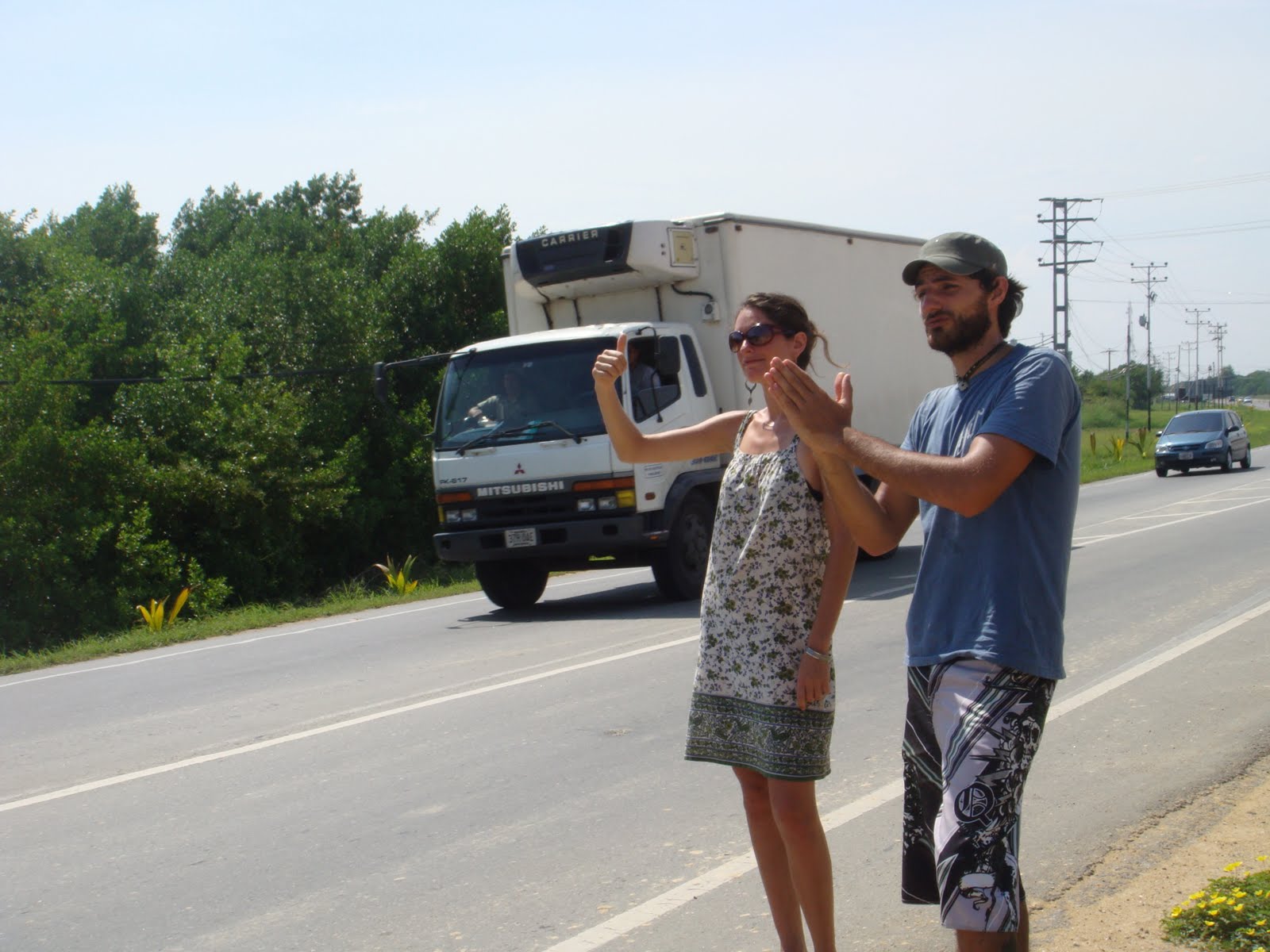
On Brazilian land we got a lift after quite a few hours out in the sun, to Boa Vista. With hopes high, we thought we might be able to arrive in Manaus by the next morning. Unfortunately no trucks were willing to stop or were heading that way. On saying that, the Brazilian warm nature shined through and many people greeted us and indicated that they weren’t going very far, at least responding to our request. That night we spent the night at a petrol station that seemed to be the hot place in town to hang out. People driving through and stopping to have a few beers right next to the petrol pump and then driving off happier than when they arrived. A couple of guys shouted us to some drinks and we found a small corner to huddle in and see the night through. More and more cars came through, blasting louder and louder music, most probably having a battle about who’s stereo is loudest. The next morning we set off bright and early with renewed hope that today would be the day for a ride to Manaus. An hour into our attempts, a motorbike crashed into the back of a truck that was turning and hadn’t put its indicator light on. The woman passenger bolted off the bike and ran to the safety of the footpath. The driver, laid in the middle of the road motionless. Cars stopped and blocked traffic from passing. The woman wailed and screeched as she attempted to comprehend what had happened to her partner. The shock of the accident shook me and I lost some inspiration for our task ahead. We lasted 6 hours out in the sun. Our hunger and thirst for shade and water made us head back to the petrol station. We spent the afternoon asking trucks that had stopped if they were going to Manaus but none of them were. We were told by one truckie that there probably wouldn’t be anyone going for three or so days. With this new piece of information in hand, we decided to fork out the $120 it was to catch the bus.
From Manaus we were to catch a ferry that would take us to Belem. The day we arrived we were informed that we had just missed the ferry to Belem and that the next one wasn’t until five days later. A ray of light shined through as we were told that we could catch a ferry to Santarem and then catch another ferry to Belem from there. We decided that this was better than waiting in Manaus for five days.

That night we were offered free tickets to the famous Teatro Amazonas by some theatre students who took a liking to us. We went to see a play called Gilda, about a prostitute and her interactions with her parents and lovers. The theatre is glorious; paintings highlighting the ceilings and gold rims trimming the seating. A pleasant extravagance and change from the five days of travel that we held behind us.

The two-day ferry ride to Santarem gave us time to make macramé bracelets and near the end of our trip, sell them to other passengers. Arriving in the early hours of Monday, we were informed that there was no boat to Belem till Friday. Shocked, tired and irritated we investigated to see if there was any way to catch a ride to Belem with a truckie, knowing that there are roads going through this part of the Amazon. Unfortunately there aren’t many trucks who make the two to three day trip and none to be found who were undertaking the journey.

Luckily in our angst to get out of Santrarem, we bumped into two artesana girls who divulged that they were staying in a very beautiful place 40 minutes from Santarem which holds one of Brazil’s nicest beaches: Alter do Chao

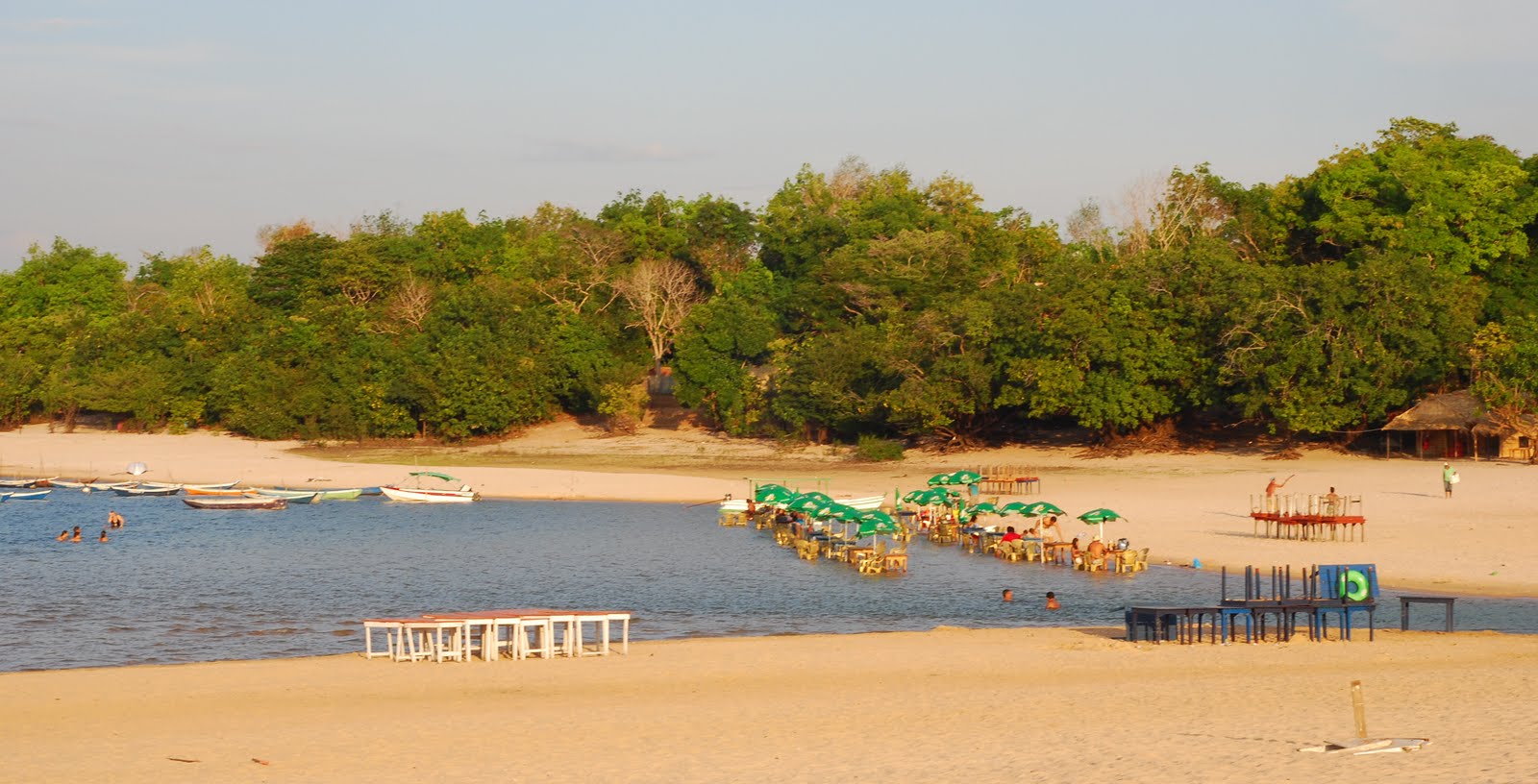
Indeed it was beautiful. Not your typical beach, it’s set on a river in the Amazon and has islands of white sand amongst crystal clear waters which are at a beautiful temperature to swim in and are completely tranquil and still. Small bars offer their tables in the shallow waters, cooling your feet as you sip or munch. The vibe is very chill in Chao, a small and pleasant village, at least during the week and out of holiday season, with hardly any souls to be seen. Here we were introduced to the cashew tree and its succulent, juicy fruit that was in abundance all over Chao. We also tried the traditional meal of tacaca which consists of a soup with goma (a tapioca gummy substance which is interesting to eat), tucupi (a broth made from cassava), dried prawns (white river ones in this case) and jambu (a para cress). It´s served very hot in a cuia, a bowl carved out of a gourd.
It’s amazing how things work out at the perfect time. Staying in Chao was exactly what we both needed after a non-stop week of travelling. I was close to cracking into pieces after little sleep, living on sandwiches and heat stricken. We were led to this beautiful place, to relax and rejuvenate when we were unable to offer this to ourselves. The reason for our visit to Chau was money orientated (as it was cheaper than staying in Santarem) but instead we were offered a holiday in paradise.

On our last night in Chao, a small gig took place on the beach with traditional music from the state of Para called Carimbo. A vibrant assortment of drums (made from tree trunks) and singing with a strong African influence, girls dancing in long, colourful dresses which they hold the ends of in their hands and the men dancing around them in circles, re-enacting the ritual dance. Definitely recommended for those musos out there!

Our ferry to Belem was waiting for us on the Friday morning as we rushed to walk from one port to the other with our heavy packs and the hot sun stumping our stride. It cost us 140 reales for the both of us instead of 200 reales which was the price in the port that we left behind (a saving of $40). The two days that it took us to arrive in Belem navigated us through the Amazon once again, passing many houses situated on the riverbank amongst the jungle, isolated from the rest of the world but located in a dazzling setting. We saw a lot of shipping of timber taking place on large platforms being pushed up or down the river. Small villages based entirely around logging companies were spotted along the way, the destruction of the Amazon rainforest sadly taking place right in front of our eyes but legal logging is not the biggest culprit, strictly monitored and operating under demanding guidelines; clearing for cattle pasture and agriculture are the most destructive as well as illegal logging.

On the last night at sunset, we encountered canoes waiting for our arrival. Small plastic bags filled with food were being thrown into the water by passengers, the canoes manoeuvring to fish them out of the river and take home the goods.

We arrived in Belem to a full moon rising from the river, tremendously orange with the appearance of a bush fire sun, it slowly made its way up into the sky, looking magnificent in its splendour.

Friday, November 5, 2010

Ranch article

An article i wrote on my experience at the ranch... click here to read

Thursday, October 7, 2010

Rancho Mastatal

To see photos click here

So three ½ months have elapsed and there’s been very little news from me. Why may you ask? Have I forgotten about this blog altogether? Have I gotten bored of relating my fascinating experiences and captivating thoughts that engross you so much!? Ha Ha! Don’t you worry... I have not tired of this. What’s happened is that I’ve been living on a rural ranch (www.ranchomastatal.com) in the tropical rainforest of Costa Rica working as a campesino and learning lots of new and useful skills such as carpentry, natural building, mosaicing, gardening and farming, baking, fermenting foods and much much more!

So what exactly did I do everyday at this ranch?

Well the day normally started at 6.45am to be in time for breakfast at 7.00am. On saying that, a couple of times a week we would get up at 5.30 am to cook breakfast for somewhere between 15 – 40 people. This would normally involve making some sort of eggs (egg toasties on occasion which is where you cut out a hole in a slice of bread and toast it with an egg in the middle…mmmm! So good!), kefir (a type of yoghurt that’s meant to be much healthier for you), fruit, pinto (which is typical Costa Rican food consisting of rice and beans) and perhaps pancakes or muffins or another delicious breakfast food like French toast.

Meals were buffet style and were always plentiful. Everyone had the tendency to over eat and go back for seconds and thirds just in case that the meal would not appear again or out of pure gluttony.

After breakfast the 7.30 meeting would happen (Agustin making a habit of loudly reminding everyone with his Argentinean accent that it was 7.30 and time for meeting; people would sleepily finish off their breakfasts looking a little flabbergasted at the sudden need for movement). Meeting involved going over the daily tasks and people putting themselves forward to do them. This might involve turning the bokashi (a Japanese fermented fertiliser that gets used in the garden), baking sourdough bread and bagels, planting fruit trees, working on a carpentry project such as making a table, feeding the bio-digester with a bag of manure (a toilet which creates methane out of peoples ‘deposits’ and feeds this gas into a gas stove that is used to cook off), making ginger beer, making candles, making soap, cutting bottles to make glasses, daub dancing (mixing sand, manure, clay and straw to build walls out of), feeding the goats and chickens, cooking, etc, etc, etc.

So once you had chosen the tasks you were interested in and meeting was over, you would go about starting your work day (which really didn’t feel like work most of the time, being such a great opportunity to learn something new everyday). You worked till lunch which was called with a conk shell (at about 12:30) and once again, you stuffed yourself stupid with amazing, delicious foods such as pumpkin tart and sauerkraut (a fermented cabbage), yucca burgers, burritos, or empanadas, all coated with a heavy layer of homemade garlic or chilli mayonnaise.

Once you fell into your food coma, a couple times a week the chocolate man Jorge would come with his temptations and everyone would gorge themselves on the indulgence while sitting about and waiting for the afternoon to start. The rains would normally accompany the afternoon work which prevented from most outdoor activity and kept people busy inside (the rainy season taking place between the months of May – November). Mammoth storms would at times take place with lightning strikes and thunderous thunder causing landslides and road cuts. .

Sometimes you may have a lunch or dinner cooking shift which involved cooking with two local girls (normally Katia and Roxy) for approximately 3 hours (this is the time it takes to cook for so many people!). The girls would chatter about town and ranch gossip while they would skilfully and quickly prepare meals and you assisted in the matter. The work day finished at the time that you wished, depending a lot on what you were doing and how committed you were to finishing the task but normally around 5.00pm. People would either have a shower (once every three or four days is what most of us became use to showering – dirty buggers!) or having a beer and appreciating the sunset hours.

Dinner would be served at around 7.00pm but would be preceded by circle time which involved everyone getting together around the long dinner table and maybe saying thank you to someone for something that they had done that day or saying goodbye to someone who was leaving the next. At first I hated circle time and always felt uncomfortable but after a while I saw the value in doing this exercise and enjoyed listening to peoples thanks and comments that were made. A nice way to finish the day even if a little hippy!

Bedtime would be shortly after dinner as you struggled to stay awake maybe due to the work that you had accomplished or the early hour that you had woken up. Everyone would retreat back to their respective accommodation scattered around the ranch, set amongst the jungle with the noises of the many frogs chirping away. On some nights the full moon would be shinning down and lighting the beautiful landscape, making it easy to walk the paths back to our houses, other nights it would be pouring down in gallons and you would try and not slip over the muddy paths on your way back home.

The wildlife was in close contact with living spaces, everything being open with mostly no doors and few windows. As I lied in bed, I often could hear huge insects buzzing around in my room, attacking the mosquito bed or flying in circles until they found their way out again. Spiders would establish their space and became pets that we greeted hello to on a daily basis. Scorpions would find their way into dark little corners, especially under clothes, or in and around wood. Toads would be hopping in and out of the main house and sometimes frogs would also make their way in. On rare occasions, snakes were seen around living quarters. The rule was if they were poisonous they had to be killed in the name of our protection.

The working week was between Monday to Saturday and Sunday was a day off. Brunch was held on Sunday allowing people to sleep in if they wished and then scatter off to an entire day of community football games or go for a hike to one of the many waterfalls or rivers surrounding the ranch.

So what did I accomplish during my time there?

I made (in conjunction with others!):
- A table in the shape of an anchor for the house that I lived in which was named after a song called starship cork
- A gate for the Choza (Tim and Robyn’s house)
- Cubbies for the main house
- A mosaic sink for the bio-digester bathroom
- A daub floor for the Cork
- Lime washed (an alternative to paint) the Chozer house and bathroom
- Planted lots of trees!
- Lots more that I’m not going to bore you with anymore…!

Some of the happenings in the 3 ½ months at the ranch:
- Agustin cutting his finger on a table saw in the first couple of weeks of arriving at the ranch and managing to cut his tendon leaving behind a nice big scar and a bent finger
- Warren acquiring an allergic reaction to mosquito and ant bites mainly obtained on the goat slope and covered with a very nasty rash
- Chepo proudly killing a poisonous snake and posing for pictures with his collared shirt unbuttoned, his signature style
- The permaculture design certificate course taking place half way through the internship, being a challenging 15 days of back-to-back classes (being use to manual work by this point and finding it hard sitting down in class all day long). We presented our extravagant permaculture designs for a porn client and ninja centre and passed. I am now a permaculture designer!
- Holding down the fort while the owners (Tim and Robyn) and most other interns went to the beach for a holiday and seeing first hand what it’s like being in Tim and Robyn’s shoes, showing around and answering the numerous questions from the new volunteers
- Tim having a bot fly squeezed of his back while a team of us squirmed and squealed at the sight of this alien tadpole looking animal popping out of his skin
- Sole’s favourite words (the daughter of the owners of the ranch Tim and Robyn): “No hay paso!” “Pupuya” “Caca de vaca!” “No importa!” “No hay campo!” “Vaya” “Yo quiero” “Poquito” “Adonde?”. A very smart two and a half year old who knew everything that went on at the ranch, where everyone was and when to speak English or Spanish depending on who the person she was addressing
- Making enough gnocchies to feed all of Mastatal to celebrate gnocchi day in Argentina (the 29th of each month)
- Warren dressing up as a goat for superhero pizza night
- One of the goats dying on us upsetting many
- Agustin falling out of the ute on the way back from harvesting mangoes, being flung off by the force of the harvesting pole getting stuck in some trees
- Michelle’s excitement whenever Michael Jackson was played and her very good dancing impersonations that she entertained everyone with
- Lina being my housemate at the cork and sharing chats on random afternoons
- Mary’s dry and sarcastic humour that took everyone by surprise at first and entertained people for the rest of our time together, especially when she impersonated Chris, our permaculture teacher’s class habits on pizza night
- Eileen playing with Sole and attentively looking after her on most days with much joy and eagerness
- Kassi falling head over heels in love with an eccentric and quirky permaculture translator, mini Chris, who’s exactly that, very mini but also loud and entertaining
- Andrea running off to live with her Costa Rican boyfriend in a village up the road from the ranch
- Vikky recounting numerous stories of her life back home in the UK, her family and her time at the ranch before we all arrived, especially her numerous encounters with jungle insects
- Robyn and her incessant care of Sole even while she is sick, addressing her every need, speaking to her like every parent should: with patience, attentively and as an intelligent human being
- Tim and his ceaseless dedication that he gives to the ranch, always willing to help anyone who needs help with great attention and care
- Eileen breaking her toe while playing soccer and being in constant pain and limping for weeks
- Tim and Robyn’s dedication to the ranch and their ceaseless hospitality, friendliness, humbleness and sharing of their home with everyone who comes through
- Amy and her very high work ethic and dedication to the task, always keen to do the shitty jobs and… “anyone want to plant vetiver?!”
- Rachel committed to the task of planting the entire ranch out to fruit trees and being an endless source of knowledge on gardening
- Bert and his cheeky smile and raised eyebrow stating that he’s finally finished building the kakhut shit shack
- Agustin coming up with a word of the day in Spanish to encourage people to learn Spanish in a primarily English environment
- Bea and I wearing matching clothes on several days and having chats about the future
- John, otherwise known as Mr. Musclos, strutting his stuff around the ranch while the numerous girls oohed and ahhed at him flexing his muscles while doing ‘manly’ work
- Mario known as the strongest man on this earth climbing up 20 metre high trees to cut down branches and harvest food at the age of 50
- Hana farting and burping her way around the ranch and sharing her bountiful knowledge on plant and animal life
- Listening to Kassi sing as if it was a professional performance at a bar, her beautiful voice affecting all of us
- Everyone tikaring themselves up for one of the two village dances occurred while we were there with the disco mobil!
- Junior and his many flings with many gringas and his amazing skills at carpentry
- Katia, the leader of the women in the village sharing her amazing cooking skills with us at the ranch
- Roxy checking out the new meat (volunteers) that kept on coming into the ranch
- Ty working tirelessly and silently on the new community library
- Agustin playing basketball and twisting his ankle and crowned accident man during his time at the ranch
- Finishing the Choza gate on the day before leaving the ranch, just in time!
- Jason hospitalised for 5 days after being stung by a strange insect and getting infected, his leg swelling twice its size
- Tiburon talking peoples ear off while at dinnertime as they slowly tried to get away
- Playing in cow poo on a regular basis in the name of natural construction!
- Eating a lot of pejibaye in all kinds of different ways… till we were truly sick of it!
- Candice coming to visit me in my second last week at the ranch! So nice to see a friend again!

Sunday, June 6, 2010

Amazon adventures

To see Amazon photos, click on this link

A 36 hour bus ride took us out of Lima, north along the coast and finally through the jungle to the end of the road where the river meets and you only have the option of travelling by ferry along the Amazon river or staying in the port town of Yurimaguas. The ferry left the next day and we stayed in a dodgy looking, but cheap hotel that reminded me a little of a hospital ward. Down at the port we slipped and slid over the slushy mud that had formed from the previous rain, which eventually took us to the ferry we were to board. We left that afternoon, slowly propelling ourselves into the famous river that is known for being the river that carries the greatest volume of water. We swung on our hammocks where we were to sleep and watched the sunset over the murky water that characterizes these rivers. Luscious jungle on either side interrupted only by a village now and then, where kids run to the shoreline to salute as the ferry passes by. Time was spent being creative, making jewellery out of macramé and reading books. We met some nice folk who coincidentally knew someone who we had gone to the meditation course with us – a small world we live in! We exchanged new macramé techniques for string and ate chocolate cake with peanut butter while smoking a little at the back of the boat. Sunsets were incredible as were sunrises which we got up for as breakfast was being served and a terrible noise could be heard of people moving and talking, not allowing you to sleep. Meal times were mostly disappointing consisting of rice and little else along with bread and margarine and a soup like consistency of porridge with very little porridge to be seen. We did taste juanes, a yucca mash with bits of fish swimming within it, wrapped in a bijao leaf and resembling a tamale, as well as camu camu, a bean like fruit which contains 40 times more vitamin c than the kiwi fruit, grilled on the barbecue and tastes rather good. Remarkably, pink dolphins were spotted at a distance as well as grey ones; I was ignorant to the fact that fresh water dolphins exist. My one-year of travel was celebrated on the boat, a fine way to bring in another period of travelling. Talks were had about joint plans for the future: Argentina with Agus after the ranch... and a new commitment was made between us.

We arrived in Iquitos, the world’s largest city that is unreachable by road, after two days of travel. A little exhausted from not sleeping properly in a shared hammock, we dived into the city and were met by a million motor taxis, roaring their engines in all directions. Quickly, we made it out of the hoard of activity and headed to a couch surfers house called David who is like a puppy dog, full of energy and excitement but also very inviting and friendly, just like his wife Rebeca. He was very sincere and open with us, telling us intimate details such as that his wife is 20 years older than he is, the disapproval of his parents and how they met and fell in love. Another storyteller lover, David told us some legends and beliefs of jungle communities in the Amazon, such as that of the pink dolphin (bufon) that impregnates pretty young girls. He told us of his cousin who apparently had this happen to her, as it’s happened to many girls in the Amazon. A famous doctor in Iquitos collects specimens of the fetuses of these aborted babies, which are apparently half human and half dolphin!

Iquitos is a city full of mysticism, traditional beliefs, shamans and motor taxis of course! A visit to the immense and chaotic Belen market will present you with a variety of exotic fruits such as poma rosa/mammee apple (a red fruit with white flesh) or aguaje (small red fruit with orange flesh), jungle fish such as the famous paiche (one of the world’s largest freshwater fish), an egg drink called ponche made out of eggs and condensed milk, tacacho made out of mashed or roasted bananas. Further along is the pasaje paquito, a passage of stalls selling traditional herbs, plants and medicines, beads and where you can find such things as san pedro and ayahuasca (a psychoactive shamanic ‘medicine’ which is prepared using two plants native to the Amazon) or any other herbal concoction to suit your needs. Impressive! Heading towards the river, you come across barbers, which are set up on the street with nothing more than a chair, scissors and a mirror set up in the outside light. Along the river in Belen, are the famous floating houses built on rafts that make up Belen shantytown. During the rainy season, people use canoes to go from one house to the other and during the dry season, many of these houses sit in the mud. It makes for a pretty spectacle watching the daily activity of people selling their goods on the river, traversing to each house in canoes. Bars, shops, churches and schools also are amongst the floating community consisting of approximately 7000 people.

On one day we met up with Alexandra, the pregnant girl in my room from meditation, who lives in Iquitos with her Shaman partner Wagner. We visited the Shamanic centre that the family owns (Capitari, centro de investigation) which has the reputable shaman, Don lucho or Luis (Wagner’s father) performing ayahuasca ceremonies and ayahuasca diets. Situated within the jungle, a quick 30 minute boat ride away and a 30 minute walk over a muddy, slippery path into the jungle, allowing you to arrive covered with mud up to your knees. People come from all over to try ayahuasca, believing in its effervescent healing properties or simply, for a hallucinogenic experience.

Wanting to get out to the real jungle, we went with David (our couch surfer) and his new and very small tour company, to a small community of 22 families called San Antonio. We glided over the Amazon river to smaller run offs that we traversed, encircled by thick jungle on either side that we could almost touch. Exactly how I imagined a jungle adventure! We spent two days walking through the jungle, spotting scattering tarantulas and their intricate webs, large termite mounds, listening to the amazing knowledge of plants that our guide holds, pointing out each plant and tree and describing what it’s used for: medicinal properties, food, construction material, etc. We adventured through as tarzans and janes and drank water from a vine while climbing up another. These vines were thick and long, launching themselves up trees and then swinging down and helping other vines to climb up. We also went on a night walk and although couldn’t see much, we heard the amazing sounds that the jungle has to offer: a variety of birds, monkeys, frogs, crickets and a rare moth that apparently has a selling price of $100. The darkness enveloped our sight and the only thing that could be seen was a half glowing leaf. The mystery that is bought about by the night made me remember the books I loved when I was little, telling of magic communities that come alive only at night, situated in the dense forest or jungle. We also went for another canoe ride but this time making our own path through the vegetation, ducking and bending down to avoid the trees and shrubs growing out of the river and reaching out at us. While watching the local final soccer championship in a community called Gen Gen, I was attacked by a white bearded monkey while I was taking its photo. I fell in the mud and made a fine spectacle for the people watching nearby! Over the soccer field, while the game played on, majestic macaws flew over of brilliant vivacious colours of blues, yellows and greens, a magnificent sight to watch.

Our boat trip to Brazil was a quick two nights where once again, we met someone hammocking next to us who was from the same community as one of the girls from the meditation course and with whom we chatted about the philosophy behind the meditation and how to live in the present moment. Another coincidence in this small world that we live in. Arriving at the three-frontier border between Peru, Brazil and Colombia, we crossed to the other side of the river and arrived in Brazil.

The ferry from the border of Brazil took us up the Amazon river over a three day journey and dropped us off in Manaus, the capital of the Amazons in Brazil. The ferry, much more luxurious than the Peruvian ones we had taken (but also much more expensive), had a sundeck and bar and served a buffet which didn’t have any vegetarian options but seemed much more substantial than what we obtained in Peru. Luckily we made friends with one of the kitchen staff (Lucia) who spoke very fast Portuguese as I looked blankly at her and smiled politely, making out a few words here and there from the similarity it shares with Spanish. She shared some of her food with me (she’s also a vegetarian) including soya and a big fish steak that would have been enough for two or three meals.

The Brazilians are much more generously proportioned than most other Latin American nations. This is obviously partly due to the fact that they eat bigger portions and a lot more meat here. They are generous with the amount of cheese that they place in your empanada and give you a big serving of eggs on your rice and yucca as well as a lot of chocolates in your famous Brazilian Garotos chocolate box. The girls wear a lot less clothes here, showing off their beautiful tanned skin and curves, with their hair gracefully slithering over their backs. Everything is much more ordered here than, for example Peru. Police in appearance, seem to perform their job properly, searching us to the full extent before boarding the ferry to the point where he was opening my condoms and lifting an inquiring eyelid at my Cuban cigars or my little bottles of homeopathy. The traffic glides with greater symmetry (or at least in Manaus) and drivers have a respect of pedestrians with no incidences of acceleration while crossing the road. The music here is full of life and vivacity; strong voices, bold and very rhythmic. To match the music is a big drinking culture of beer. The beer here is light which encourages people to drink as much as possible as it flows like water especially with the heat of the day.

Manaus was a stepping-stone to continue north up to Venezuela and making our way back up to Costa Rica. We took a short bus trip out of the city on one morning and waited on the side of the road for a ride. Cars passed us by and signalled to us that they weren’t going very far but none stopped until 3pm in the afternoon. A Brazilian/Italian/German (Luis), chatted to us in his broken Spanish mixed with Portuguese, telling us about the indigenous jungle community near the lead mine where he works, which still practices its traditional customs and traditions and has been known to be a little aggressive at foreigners (understandably), and that there’s a pulp mill (Jari project), which was bought over from Japan, built in the form of a ship, which holds tree plantations the size of Germany and Belgium combined. This is the sad state of affairs in the Amazon which we also observed in Peru, seeing vast amounts of deforestation either caused by companies or locals trying to make a buck or two, chopping trees to make charcoal. He took us to a petrol station, located five minutes out of the indigenous reserve. It was five pm by this point; the sun was setting and transmitting glorious light over the sight.

We had little hope that we would get a ride at this point but the gods were working in our favour that day and sent us an angel disguised as a truck driver (Juan Carlos), who was going up to the border (a short 18 hours away!) and then continuing to the North Coast of Venezuela, exactly where we were heading! Not believing our luck I smiled internally at how things work out. We crossed the reserve with great caution. The road being broken up by plummeting potholes and regions of skimming mud that at times, trap your tires into their dreaded depths. Weaving from one side of the road to the other, trying to miss the holes in the ground, we listened to tales of onza sightings on the road (a feline) and spotted a snake and several alligators crossing the road in the pitch black. The jungle looked amazingly thick and wild, the type that spits you out in pieces after entering. In comparison, the Iquitos jungle we visited now appeared tame; training wheels until your ready for the real thing. Rain poured down in gallons at various intervals during the night, adding to the difficulty of the task of driving and spotting the potholes. The rattling of the truck due to the situation of the road and the lack of suspension, made it hard to sleep in the sleeper, fitted with a full sized mattress. But I managed to rock myself to sleep and woke up to the light of day, Juan Carlos having slept just one or two hours throughout the night and still being in fairly good shape. He has 28 years of experience being a truck driver, crossing the Amazon jungle and visiting many countries on his jobs, learning Spanish as he negotiated with the border crossing guards. Originally from Brazilia, he moved to Manaus and found himself an Amazonian in exchange for his previous wife.

A couple of hours before arriving to the border, we acquired a flat tire on the front wheel and had to stop to change it. It was a complicated process that took a good hour and involved taking out a lot of tools, a lot of strength to get the tire off and a lot of grease. The job complete, I was alarmed to see Juan Carlos throw the old hydraulic jack across the road and into the wetlands, contaminating the water in an instant with grease, oil and grime. I asked him why he would do something like that and he responded simply that it was now useless. Agustin interrupted and quietly told me that it wasn’t the time to be saying anything after a frustrating hour of defying tires, strong sun and with little sleep the night before. A very sad sight all the same and something that many do in these parts without a thought.

Arriving at the border at midday, we were told by Juan Carlos that we had to part ways as crossing the border for trucks involves a lot of paper work and a few days of waiting for approval. Surprised, we jumped out of the truck and with little enthusiasm, went through the process of getting our passports checked and stamped from the countries we were leaving and arriving to. Having no luck with rides after an afternoon of standing in the sun once again, we camped near the bus station in a family’s front garden and rose at first light to try our luck again. Ready to catch a bus out of Santa Elena, I was surprised that someone stopped to offer us a lift 300 kilometres up the road. Little was said until halfway through the trip when Antonio started to chat to us, maybe as he became more trusting of us. We exchanged banalities on how much money things cost, the military and the excessive checkpoints along the roads (we were stopped four times and asked for our passports, checking the contents of the truck in a small 200 kilometre radius). He dropped us off in a village called El dorado where once again, the sun hit down on us like fire. Two young social workers who work for the government gave us a lift to Turemne, a town where we could catch a bus from. They chatted to us about the positives of the fairly new socialist government in place in Venezuela. They were 100% behind Chavez and believed in the reforms that the government is currently undertaking. They explained that their work comprised of helping communities to organise themselves, to take control of their situation and address their needs according to how they see fit. They claimed that the government has provided the country with free education, free health and is encouraging the population to be actively involved in politics and managing the country. They admitted that this was just the start and that time is the essence of change. They also admitted that there is a lot of resistance including within the government, where there are many who are quite comfortable in their positions and don’t want to loose any of their control or benefits to the communities. They recited to us the new socialist ethics declared by Simon Bolivar which are at the basis of the Venezuelan national project, both seeming very passionate and dedicated to their work. At Turemne we were about to buy our bus tickets when I proposed to wait half an hour for no particular reason, and within this time, we got a ride to Tupata with Gregorio who likes to sing in English and has a talent for languages. With a big smile and an inquisitive eye, he dropped us off at Tupata bus terminal where we made it just in time for the bus to Maracay. A passenger on the bus informed us that the bus that we were to catch from Turemne had broken down which meant that all the passengers had to wait 24 hours till the next bus. I had followed my instincts on this one!

The next week was spent in Fabiola's apartment (an amazing couch surfer who has healed herself through meditation and now organises empowerment workshops for women), with a little break at the beach for a spot of fighting, a touch of getting robbed while camping and a bit of baywatch action by Agus when a drunk man got himself in a tussle and had to be saved from drowning. We shared many laughs, stories and meals (including pizza made by Agus in celebration for my one year of travelling!) and Fabiola told us about the changes that she had noticed since Chavez took power. She mentioned that sometimes there are some food basics lacking in the shops such as milk or butter, that there is less freedom such as not being able to have more than a certain sum in US dollars and that people seem to be unhappier than before.

With one camera down and one hero lifesaver made, we left Maracay as the rainy season was commencing and dodged the rain as rides took pity of us from time-to-time. Difficultly, we searched for a ride at a petrol station, asking everyone we came across and obtaining various responses, few being positive. Manuel was one who was. He took us from Velencia to Savaneta and chatted to us, like most people are willing to do in Venezuela, about the political situation here. There seems to be two clearly marked camps; those who are in support of Chavez and those who are opposed. Manuel, like many whom we had met, is against for various reasons. On the up side, petrol costs 4 cents per litre in Venezuela, cheaper than water, it's given away, encouraging people to drive everywhere - not such a good thing considering environmental issues.

People carry deep rooted fears of the stranger here, the media constantly talking about the gangs that are apparently growing more and more out of control and this idea has submerged people's heads. One truck driver gave us a lift after I came looking for a ride during the early night at a street eatery outside a petrol station. The girls serving convinced him (or forced him) to take us. He told us that in his three years of working as a truckie, he had never given a ride to anyone for fear that they might attack him. That night, we spent what was a very long night on the road, next to a police check, waiting for the bus that never came which was apparently going to the border. We eventually made our own way there and left Venezuela 10 days after arriving, having seen very little but with the craving of wanting to see more from the country of belleza, much nature and gorgeous people!

Santa Marta was one of two stops we made in Colombia this second trip around, mainly for the Caribbean beaches available here. It is the oldest city in Colombia constructed by the Spanish and has a relaxed tropical atmosphere about the place. I had forgotten how friendly the Colombians are, full of life and energy, they make cities especially on the coast, vibrant and entertaining. We met an artesano who lives off selling macrame jewelery, living a nomadic lifestyle, travelling from one country to the next, he taught me a new knot, showed us his intricate necklaces and bracelets which he had made and entertained us with his stories of life as a gypsy.

A few days later, catching the plane from Cartagena (Colombia) to Panama, we were told that we wouldn't be allowed entry into Panama if we didn't have a ticket out of the country. We didn't and frustrated and angry, we were forced to buy a ticket online with five minutes to spare before check-in closed. In Panama, we mainly got to know some of the couch surfing group there who were very welcoming as usual, and big partiers. After many months of not going out, we went out two nights in a row and I was reminded how it felt. Meanwhile, a huge fiesta was happening in Sydney that same weekend for Mun's 40th Birthday, saddening my heart that I wasn't able to be there for it.

We had another adventure heading to Costa Rica catching many rides in the pouring rain and a late night sleep at a small town's petrol station where we slept for a maximum of 2 hours. In the early morning we hitched with a kind bus driver and managed to make it all the way to the small community of Mastatal where there's very little transport (but got lucky and got a ride with the school teacher). Now we enter a new chapter in our journey: Rancho Mastatl, working as a volunteer for 3 months at this ranch located in the Costa Rican jungle...!

Saturday, June 5, 2010

Meditation Course Vipasana Diary

Day before day 1 – We arrived at the centre in the afternoon and were allowed a few hours to register, find our rooms and settle in. Soup was served at 5.30pm after which point the boys and girls were separated by a great big plastic sheet. Apart from segregation of males and females, we were also forbidden to communicate in any manner with other students in the course. We were each given a number which designated where we were to sit for the 10 days within the meditation hall. I was at the back (46), with a good scanning position of the room, unfortunately with no wall which I was to find, would have made life a lot easier! But easy is not the point of meditation… Agus sat on the other side of the hall, the men’s side. This is the first time we’ve been separated in the four months we’ve been travelling together. It will be strange but good for both of us I think. We listened to a tape that night (like we would be doing every night for an hour) by a meditation master called Goenka, an Indian guru who has propagated Vipasana meditation throughout the world (the meditation that Buddha practiced), describing the technique we were to practice – focusing our minds on our breathing. I was in bed by 9:15pm.

Day 1 – Woken up by a tingling bell at 4:00am, I additionally had the pleasure of waking up with a Bali belly again, this time with the taste of rotten eggs in my mouth that kept on ‘popping up!’, also known as Giardia. No help came from the supervisor, taking the opinion that it states in the course guidelines that we should be in good health before we come to the course – fair enough, although a bit of compassion wouldn’t go astray! One of the women in my room (a psychologist) can’t handle not talking and every opportunity she has, she lets off a few words at anyone who dares to listen. Am slightly getting annoyed by her.

Day 2 – Woke up in the middle of the night again by the sound of buzzing mosquitoes around my head. I keep on shutting the windows when night falls but the psychologist keeps on opening them. We’ve left the window’s open as it can get stuffy at night but I’d rather be a little hot than attacked by mosquitoes every night. Started to eat today after feeling weak from not eating yesterday. Meditation is hard work. So many thoughts going through my head and my mind seeming to do everything but concentrate on my breath. It seems to have a mind of its own. Oh, but the food is awesome, opposite to my preconceptions; vegetarian, good variety and real tasty (lots of quinoa, a traditional grain from Peru and the Incas). Shame about the supper though, our last ‘meal’ for the day only consists of two pieces of fruit and I’m damn hungry!

Day 3 – We’re told to focus our attention on any sensations that appear around out nostrils. I am able to do it but the sensations are limited and my mind is quickly distracted. On another note, was almost kicked out of the meditation course today…! Was called into the principles offi… I mean, to see the teacher during question time. I thought it was to see how I was doing but instead it was to give me a lecture. First he told me that there was nothing that they could do or give me for being sick at which point he asked if I was well enough to continue the course. Then he rambled on in a shrewd manner about having to live in circumstances that are a little basic for ‘us’ westerners (he’s from Texas, not your typical guru!) and that we need to be ready to compromise. I wasn’t sure why he was saying all of this so I asked if there had been a complaint placed against me and he responded that there had been; one of the girls in my room (the psychologist) complained about me shutting the windows at night. I got angry and said that this wasn’t the way to deal with the situation by accusing and attacking me without previous consultation of my side to the story. I left feeling as if my meditation course had been tarnished and that the teacher was not as wise or noble as I expected. He’d pulled out the western comforts card when he didn’t know anything about me and how /what I was use to. Maybe I did need to see the other point of view but there was no need to say “if you don’t think that you can be tolerant and compassionate to others, then maybe this is not the place for you…”. My initial instincts were to leave, but I thought better and decided to swallow my pride and stay on. I changed rooms that afternoon, to a room with two girls instead of three women. They seem more light-hearted and I like the vibe better already. The mosquito problem hasn’t changed as I’ve been told that I can’t close the windows, as one of the girls is pregnant.

Day 4 – Today is the big day where we learn the actual Vipasana meditation – what we came here to learn and have being preparing for over the last three days. We’re now told to focus our attention on sensations from head-to-toe and continually doing rounds trying to feel the subtlest sensations. We’re also told not to associate any emotion to the sensation whether it be e.g. pain or pleasure, we are to feel total equanimity for all sensations. We are also told that the law of nature is that everything is impermanent including sensations (this is called anicca in pali language); they come and go. The meditation is seen as a method to liberate us of our sankharas (conditioning of the mind/impurities of the mind). These are divided into two categories: aversion and craving. By not reacting to our sensations we are subconsciously dissolving our sankharas. So we are now made to sit for an hour three times a day without moving and holding our eyes shut for the entire time. The first hour in the morning is bearable but the last hour of the day is very uncomfortable; your back hurts, your legs hurt, even your eyes start to heart from being forced shut for so long. We are told that pain is all in the mind. If you start to analyse the pain it will start to lessen and then disappear especially if you don’t associate negativeness towards it. As I’ve heard before, Goenka tonight stated that the ‘I’ is a made up person, a person who we have created in our minds who is this or that person and has so and so likes and dislikes… and gets offended when people say things against this ‘I’ (ego) but in fact, ‘I’ is a person that we have created in our minds. We also make up stories about the people around us, which aren’t the truth, but we believe the story and invest a lot of time in developing the story, in proving ourselves right in our story.

Day 5 – Last night I had what comes under the name of explosive diarrhea, frequenting the bathroom several times before falling exhaustively to sleep. I got up at 4:00am as usual but this time, decided that there was no point trying to meditate and went straight back to bed sleeping until after breakfast (so sweet!). I wasn’t sure if I could last till day 10 feeling like I did but now I feel better and think I can make it. I’m willing the days on though, which I don’t think is a good thing; I’m meant to be enjoying this time of reflection but being sick doesn’t help especially when I have no one to speak to and no one to give me compassion. ☹

Day 6 – The ground beneath us started to shudder at 3:30am in the morning, waking everyone up. I was dreaming of a train approaching a platform at the time and thought the earthquake was the train rattling the ground I was standing on. The tremor passed in 10 seconds and chatter could be heard throughout all of the rooms as people shared their emotions. Today, all I can think about is food. As I try to focus on the sensations in my body, images of food pop into my head, things that I haven’t eaten for ages I am now craving. It makes it hard to concentrate. During break times, everyone sits in the small oasis of 20 square metres of grass and enjoys the sun that shines upon us. We must have an appearance of mental patients, all sitting relatively close but separately to each other, not talking, off in our own worlds staring at a blade of grass or into space with a gaze of admiration. Goenka on the tapes says that we are performing surgery on our minds during these 10 days, the figure of speech being quite appropriate therefore.

Day 7 – Today I seem to be able to focus my mind better and am able to feel a lot of vibrations and tingling throughout my body. The images of food have diminished and instead, in my lapses of concentration, I have relinquished to think of all my friends and family. I go over each person in great detail and think about particular times and experiences that have occurred. Now you know why your ears have been burning! I have also forgiven the psychologist for what has occurred and see that she didn’t mean any harm by what she did and that it’s her nature; she’s like a child who wants it all right now, her way. The supervisor has once again told me off for smiling at another girl who was mumbling something to me. I’m not sure if all the supervisors are like this in each meditation course but I believe that she’s being overly strict for supervising a meditation course. I feel that I am being treated as a school kid, unable to think or decide anything for myself. We are all adults, here on our own accord, let people breath and enjoy the time, otherwise meditation will be seen as a chore. The teacher and supervisor look onto the meditation hall with scrupulous eyes, checking to see if all students are present and in their designated spots. If you’re not, the supervisor goes to look for you or tells you to move back to your spot, away from the comfortable wall you have escaped to. We all walk like zombies towards the food hall, waiting for the gong to call us in, praying for the gong to sound, urging it to, craving it to... “we want food”, everyone silently shouts. Food is a welcome pause to the 12 hour meditation day. In the morning we listen to half an hour of singing by Goenka. It’s calming and tranquil to listen to. Later, I will the hour of meditation on. An hour can sometimes seem like a lifetime. I reach 45 mins and it starts to become unbearable. I will the 5 mins of singing to start which means the termination of the hour.

Day 8 – I’m feeling much better now. Am eating fine, am hungry and the egg burps seem to be a thing of the past! Tonight the teacher played a game of cat and mouse, poking his head through one of the doors leading onto the hall and two seconds later, out the other door on the other side which provoked stifles of laughter from a few of us who watched the proceedings, making me think of Manuel from ‘fawlty towers’. It felt great to laugh again after being buried so far in my thoughts. I treated a girl for diarrhea today and it worked, thanks to my homeopathic pack! Tonight we were given a new task of meditating constantly till day 10, even while we’re walking or in the bathroom, to always be conscious of what we’re doing and being in the present, observing the sensations even while we’re about to go to sleep! I went to see the teacher to see if he could enlighten me a little upon a few philosophical matters!: Are our sankharas meant to just disappear through doing meditation? Are all feelings and emotions meant to subdue through meditating? There’s a fine line between liking and wanting or craving. Is it wrong to like something and want to enjoy it? He wasn’t able to answer any of my questions, as they’re philosophical rather than technique specific and instead, he said could be asked on day 10. He didn’t seem like such a bad person up close again. I’m going through a moment where I feel that the technique is taking shape and becoming more and more understandable. I’ve even forgiven the supervisor for acting the way she did, she didn’t know any better. I feel like I have let go of resentment, something I often do when someone acts ‘negatively’ towards me. I can forgive them and know that they’re doing their best and move on.

Day 9 – Today is the last day of ‘noble silence’ and they say, the last day for serious meditation. I had an awesome session this morning in the 1st group meditation. I didn’t move for the entire hour and I concentrated hard and felt many buzzing, tingling and fluid sensations. This afternoon was a little harder. I always seem to struggle in the arvos, lots of thoughts entering my mind and I’m distracted easily. The philosophy of the meditation has been preoccupying my thoughts a lot. I’m really unsure how we’re meant to combat negativity sometimes. I don’t know what to tell myself to change the negative to positive, while believing what I’m saying.

Day 10 – We were allowed to talk today after learning metta, a short 5 minute meditation where we focus our energy on sending positive energy out to other people. Speaking again was strange. It felt unusual and a hard act to complete. The hum of noise that was created by people chatting, was almost too much to take. When meeting the girls from my room we exchanged warm hugs and finally presented ourselves after so long of living with each other and not knowing each others names. Later, I sat in a peaceful part of the centre with Agustin and we shared our impressions and accounts of the course while feeling excited about being with each other again. There wasn’t any moment to ask questions about the philosophy but talking to a few people put some doubts behind me. I felt peaceful and content and happy to be alive and in the present moment.

Upon release from the meditation course, I felt bedazzled and dazed by the outside world, unable to cope well to the traffic and chaotic driving, the copious lights that make up the cityscape and the noise that comes with 9 million people. We had luck on our side, not knowing where to go after the course, one of the organisers (Santiago) invited us back to his place even though he knew that his flatmates would get annoyed with us staying there. It was a peaceful and comfortable house in a rich area of Lima by the sea. Living with someone who knew what we had just been through and could understand our disorientation helped a lot in these initial days. Santiago, an adorable and amusing personality (who had once been a character on a tele novela, a soap opera), full of passion for life and a childish hunger for involving himself to the fullest capacity. He was always ready with an amusing and entertaining story to share and generous with everything he owns. One of the girls on the meditation, Veronica, had just learnt to drive and took us on a drive around the coast of Lima. It was a spine-tingling affair, driving with crazy Lima drivers while Vero did her own thing and amused everyone who was back-seat driving. On one of our nights there, we met up with a group from the meditation to celebrate Almendra’s birthday, one of the girls in my second room. It was nice to feel as if we had a group of friends after so many months of speedy encounters and sometimes, superficial interactions with people.

Tuesday, June 1, 2010

The back road to Machu Picchu

Desert surrounded our 360 degree vista as we journeyed towards the monstrous capital of Peru, Lima. It follows the sea juxtaposing a beautiful depiction. The vast and flat desert dotting the coast from north to south is an unusual sight in Latin America, more commonly decorated with mountainous land and green vegetation of some description. Large murals of advertising breaking up the monotonous trip along with the odd shack made up of a combination of weaved palm, wood and adobe. It was hard to imagine anyone living out in what seemed to fit the definition of ‘middle of nowhere’ perfectly. In parts of the desert we saw agricultural land forced in place (we spotted many asparagus plantations) with irrigation coming from the distant mountains. Chicken raisers are also spotted now and again in the desertic sand seeming like an unusual place for chickens to me.

Peru is chaotic and disorganised. All roads within Peru are being dug up just in time for elections. Sand dunes merge into cities. Political and religious messages are written with painted white rock in the mounts of sand or rock, able to be seen from a great distance. Motorcycle taxis are everywhere, winding their way in every possible direction. Mounts of earth are piled along the roads and mud slides form the footpaths and streets after a hard rain. People construct their shacks creating citadels on land that isn’t being used by anyone, many (approx. 200,000) having been internally displaced by the political violence from 1980 - 1993. Generations have been born here with many more to come, the land often still not belonging to them in the eyes of the law.

The man who took us to Lima (Marlo with his luxurious car), after standing for 2 hours in the piercing hot desert sun at the toll booth, is a lawyer and an active member of the political party, Partido Popular Cristiana, who consider that times have changed and we need to start attending and supporting the middle class instead of the poor. We had opposing views to say the least.

We made it to Lima with my stomach grumbling from hunger. Marlo generously invited us to a lavish lunch, mine consisting of a mountain of battered seafood, too much to finish in one go. He took us to the bus station and upon our goodbyes, inserted 100 soles (approximately $30 US) into the hands of Agustin.

All the buses heading to Cusco were full and it looked as if we were going to have to spend the night in Lima. Luckily, some dodgy coach drivers told us that they could take us and snuck us out onto the road to wait for the coach, away from the scrutinising eyes of management. There were exactly two seats left (which had been paid for but the passengers hadn’t shown up) which we happily filled. Later that night, I started to feel sick in the stomach. The discomfort worsening as the night inched on until my body couldn’t hold it any longer and I threw up, aiming with precision into a small plastic bag, all the seafood that I had consumed. One toilet stop later, I started to feel a little better when one of the coach drivers came to find us to tell us that we were to go into hiding as the coach inspectors were getting on in a few minutes. The bus stopped and we were showed to the ‘deluxe suite’, a luggage compartment turned into a bed. We comfortably hid from the inspectors and at the same time slept like babies for the rest of the night. A few microphone calls later and an hour of waiting, we were let out of our hideout and were able to enjoy the beautiful scenery of the Andes mountain range, green pasture, luscious curves in the landscape with llamas, alpacas and sheep dispersed amongst the way. Small villages appeared now and then, the houses made out of adobe appearing quaint with a rustic charm.

We arrived in Cusco after 30 hours of coach travel and 60 hours in total since we had left Cuenca. I was delirious from so many hours of travelling. The mattress and the motionless room were heavenly after so much drifting and little sleeping.

Cusco is the cultural capital of Peru and the ancient centre of the Inca civilization, considered to be the naval of the earth by the Incas. The city and surrounding terrain possess numerous ancient Inca temples (Huaca in Quechua) that have been uncovered as ruins which are the key to unfolding the history of the Inca empire. These Huacas were placed at certain points along lines that the Incas believed radiated out from Cuzco, creating a sacred landscape along with particular sacred mountains. Qoricancha is the principal temple of the Incas, covered almost entirely in gold (which was looted by the first Spanish conquistadors), with life-size gold corn and solid gold treasures such as a replica of the sun and llamas. Qoricancha holds the finest stonework of the Inca empire with curved walls, mortise and tenon stone blocks (sometimes being unable to see where one stone ends and the other commences) and trapezoidal architecture which has withstood the many earthquakes that Cusco has suffered. Religious and agricultural rituals took place here, with chambers dedicated to the sun, moon, stars, thunder and rainbow, as well as being a place from where high priests studied the stars and constellations to foretell the future and prepare the Inca empire. Pachacutec (the first Inca emperor), designed Cusco in the shape of a puma with the head being what is now the ruins of Saqsaywaman. A zigzag of immense and impressive stones is said to be the teeth of the puma, making a large wall that was used as defence in times of attack. The wall holds a stone that weighs over 300 000 kilos as well as a stone with over 18 edges. Nearby to Saqsaywaman is a ceremonial stone bath that holds pure spring water that flows through fountains that amazingly still function to this day. No one knows where the water comes from! Pisac citadel, another Inca Huaca, is set up high looking over the Urubamba valley with plummeting gorges on either side of the fortress. It has well constructed agricultural terraces which contour the mountain they are placed upon, forming an amphitheatre shape. These terraces have micro-climates which help different crops grow at different temperatures. Ollantaytambo fortress is like all Inca constructions, another breathtaking (literally as you walk up the many steps) Inca creation. The stones used to construct Ollantaytambo were obtained on the opposite side of Rio Urubamba, up on the side of a high mountain, 6 kilometres away! Man power was the only tool they had available to lug these massive stones down a mountain, through a river and up another mountain, using well-thought out techniques such as putting the stone on top of logs and pulling with rope.

Pumas, condors and serpents were sacred animals for the Incas, relating to the three worlds: the condor relates to the higher world, the puma relates to the world of the living and the serpent relates to the underworld (the three worlds are also represented by the Chakana, the Inca cross). These animals are repeatedly seen in the mountains surrounding the Inca cities and villages and within the temples and fortresses that the Incas built. Rainbows are significant in Inca cosmology. The 24th of June is the start of the winter solstice (Inti Raymi, an ancient Inca ceremony celebrating Inti, the sun god) and is marked repeatedly in Inca temples by the sun illuminating a certain stone and creating a particular shadow, indicating to the Incas the time of year it was.

Everything the Inca’s created was extensively thought-out, calculated and designed with a specific purpose and meaning in mind. What is impressive is the difficulty of construction that the Incas achieved, choosing sites which are almost always perched precariously on mountain tops, looking over stunning views.

The night before our journey to Machu Picchu saw us considering the option of walking the 30 kilometres along the train tracks to Machu Picchu. A motor taxi driver told us that the security had been reinforced and that it was now almost impossible to bypass the guards to get onto the tracks. Instead, we decided to take the back road to Machu Picchu which with a combination of bus, taxi and walking would get us there the next day in the afternoon. First we caught a bus to Santa Maria, spent the night there and caught a taxi to Santa Teresa which turned out to be a hair raising ride on a very narrow strip of dirt road where two cars had difficulty passing at the same time and which featured a steep and tremendous cliff edge on one side of the road (not the normal route to Santa Teresa as there had been land slides in the last few months). We walked two hours through desert like land surrounded by mountains, passing over a storming river while sitting in a small cable car which we had to run ourselves by pulling on a rope it was attached to. Along the way we passed a massive waterfall bursting out the side of a mountain with such force and quantity that I was amazed that the earth around it was still upright. Part of the road that we would have followed before the rainy season was entirely washed away leaving a large gap in the side of a mountain, nature-taking control once again. The mountains felt awe-inspiring and humbling at the same time, as we passed through the valley that the rio Urubamba flows through, making me think of how insignificant we are in the vastness of the world and how tremendous nature is. Reaching Hidroelectrica (the hydroelectric power station), we started walking on the train lines that was bordered by thick jungle vegetation on one side and rio Urubamba on the other. We walked another two hours in the heat of the day and at last, exhausted, reached the village at the bottom of Machu Picchu called Aguas Calientes.

Machu Picchu was misty in the dawn of the day, the trees protecting our passage up the steep and numerous steps leading to the entrance of the ancient city. Catching our breath at the top, I was caught by surprise when looking to my right after walking up some stone steps, I caught a glimpse of Machu Picchu, the glorious citadel lying magnificently in the early light of the day. The sacred grounds carry a mystical and mysterious ambiance, emphasised by the largeness of the mountains which encircle the wondrous place. We filled our lungs with pure air and set our legs for inclined trekking, climbing up Wayna Picchu, a mountain nearby the ancient metropolis which once attaining the top, allows you to view Machu Picchu with greater clarity especially on a sunny day that has finished waking up. The intricacy of the site is bewildering; to think that it was all built by hand, with accuracy and complexity that stuns all. The extensive dwellings, plazas, baths, temples and living quarters composing the place are all built with extensive calculations in relation to the stars, sun and the moon. We stayed for hours and wanted to dwell about for longer but had to start our long journey back to Cusco. We were both very tired from walking up and around Machu Picchu but with a bundle of carbs in our stomach we energised our way back and finished the walk in three hours instead of the four it took us on the way there. We arrived in Cusco at 4am the next day. Arriving at a hostel, Agustin had the bitter surprise of missing his wallet adding a slight sourness to what had been an adventure-full and energetic few days in sacred Inca territory.

We had embarked on such hectic and tiresome travelling so as to be able to participate in a meditation course in Lima. We took a coach back to Lima but this time, it didn’t turn out to be as horrendous as on the way there. Vendors came onto the bus at every major town and hawked their wares by either going from seat-to-seat and showing you their products or by standing at the front of the bus and making a discourse about such and such miracle product for so and so disease. I felt scattered and tired from so much travelling, craving for a place to relax and stay at for a long period of time. I didn’t feel prepared for meditation but I knew that it was now or never.